
You’ll win more customers online by choosing one clear offer with a simple outcome, then focusing on two channels where buyers already search—usually Google and your website. Set up and optimize your Google Business Profile, collect fresh reviews, and keep your NAP consistent across directories. Make your site fast, mobile-first, and built around one strong CTA per page. Publish customer-focused SEO content, use social proof on social, and track every lead with UTMs and call tracking to scale what converts. Next, you’ll see how to turn this into a weekly system.
Key Takeaways
- Choose one clear core offer, set a simple price, and promote it consistently on two channels where buyers already spend time.
- Optimize your Google Business Profile with accurate details, real photos, weekly posts, and fast review requests to boost local visibility.
- Improve website conversions with fast mobile pages, clear headlines, one primary CTA, short forms, transparent pricing, and trust signals.
- Publish SEO-focused content and short social posts that answer customer questions quickly, showcase proof, and guide visitors to the next step.
- Track every lead source with UTMs, call tracking, and CRM attribution, then cut low-margin channels and scale profitable campaigns.
Choose Your Offer, Channels, and Weekly Plan

Before you post another update or run another ad, decide exactly what you’re selling, where you’ll sell it, and what you’ll do each week to keep momentum.
Pick one core offer with a clear outcome and a simple proof point (results, guarantee, or demo). Match it to two channels where your buyers already spend time—search, local directories, email, or one social platform—and ignore the rest for 30 days.
Set Pricing strategies by testing one primary price and one limited offer, then track conversion rate and average order value.
Build a weekly plan: publish one helpful post, send one email, ask for two referrals, and follow up on every lead within 24 hours.
Prioritize Customer retention with onboarding, check-ins, and a repeat-purchase incentive.
Set Up Your Google Business Profile for Customers
Once you’ve chosen your offer and the two channels you’ll focus on, lock in the channel that captures high-intent local buyers: your Google Business Profile. Claim it, verify it, and make every field accurate: category, hours, service area, and phone. Add a tight description that matches what customers search, then upload real photos of your storefront, team, and work. That’s Profile optimization that lifts map rankings and call volume.
Use Posts weekly to promote one offer, one update, or one proof point. Turn on messaging if you can reply fast, and seed Q&A with the top five questions you hear in-store.
Ask for reviews immediately after a win, respond to every review, and log insights to track calls, directions, and searches—your baseline for customer engagement.
Make Your Website Convert Clicks Into Customers
Even if your Google Business Profile drives the click, your website closes the deal. Treat every page like a sales conversation: confirm what you offer, who it’s for, and what to do next within five seconds.
Tight User experience wins—fast load times, mobile-first layouts, scannable headings, and one primary call-to-action per page. Keep forms short, show pricing or ranges when possible, and answer objections with FAQs, guarantees, and clear policies.
Use trust signals: reviews, certifications, photos of your team, and recent work.
Make your visual branding consistent across pages: colors, typography, and imagery should match your signage and profiles.
Track conversions with goals, then A/B test headlines, CTAs, and page length.
Remove broken links, distractions, popups, and clutter.
Win Local Customers With Local SEO Basics
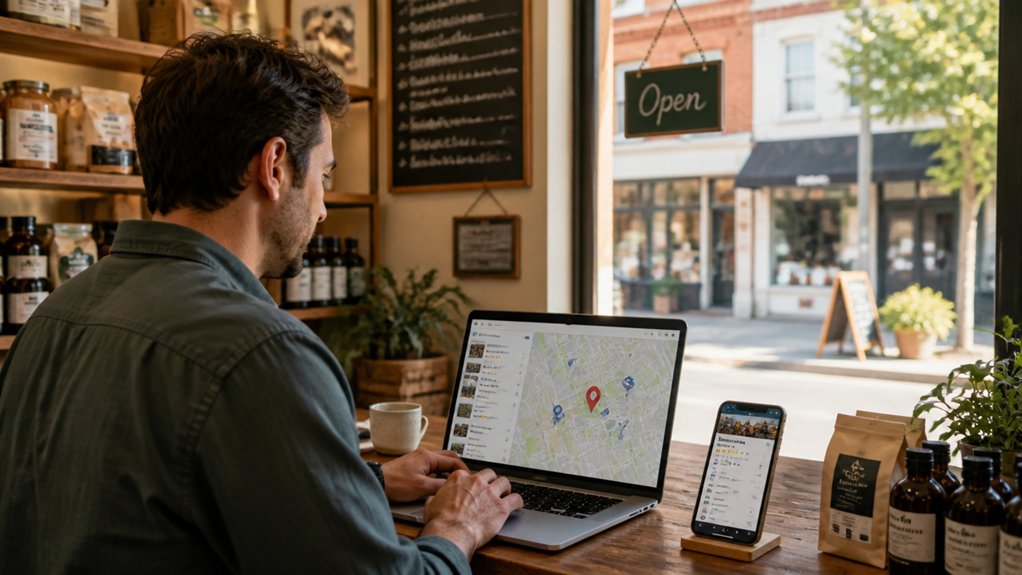
To win local customers, you’ve got to show up where nearby buyers search, and that starts with an optimized Google Business Profile.
You then reinforce relevance by tightening local keyword signals across your site, pages, and content.
Finally, you protect trust and rankings by building consistent NAP citations (name, address, phone) across directories and platforms.
Optimize Google Business Profile
Three fields in your Google Business Profile can drive most of your local visibility: your primary category, your services/products, and your business details (name, address, phone, hours).
Pick the closest primary category, then add secondary categories only when they truly match what you sell. List services or products with clear names and pricing ranges so Google and customers can compare you fast.
Keep NAP and hours exact everywhere you control them; even small inconsistencies can suppress rankings and calls.
Next, build trust signals inside the profile. Add high-quality photos of your storefront, team, and completed work, and refresh them monthly.
Turn on messaging, respond quickly, and use Q&A to preempt objections for better Customer engagement.
Publish short updates and offers to boost Brand visibility and drive actions.
Strengthen Local Keyword Signals
Because Google tries to match nearby searchers with the most relevant option, you need clear local keyword signals across your site and citations. Start with local keyword research: map “service + city,” “near me,” and neighborhood phrases to specific pages, not your homepage alone.
Put primary terms in title tags, H1s, first-paragraph copy, image alt text, and internal link anchors. Reinforce relevance with location-specific FAQs, service-area blurbs, and embedded driving-direction cues.
Align your category language with what customers actually type, and mirror it in your GBP services and posts. Finally, audit mentions of your business across the web for citation consistency in names and descriptors so Google reads one theme, not many competing variants.
Build Consistent NAP Citations
Local keyword signals work best when every place your business appears online confirms the same identity. That means your Name, Address, and Phone must match character-for-character across Google Business Profile, your website, directories, maps, and social profiles.
Prioritize NAP consistency: pick one official format (Suite vs. Ste., street abbreviations, toll-free vs. local) and use it everywhere.
Audit your top citations first: Google, Apple Maps, Bing Places, Yelp, Facebook, industry directories, and data aggregators. Fix duplicates, old addresses, and tracking numbers that split trust.
Maintain citation accuracy by documenting your canonical NAP in a shared file, updating listings immediately after any change, and rechecking quarterly.
Consistent citations reduce confusion and strengthen local ranking signals and calls.
Rank in Google With Customer-Focused SEO Content
If you want to rank in Google, you can’t write SEO content for algorithms alone—you need pages that answer real customer questions fast and clearly.
Start by mapping your top searches to intent: “price,” “near me,” “how long,” “best for,” and “vs.” Build one focused page per intent and put the answer in the first 2–3 sentences.
Use plain-language headings, bullets, and FAQs to earn featured snippets and reduce pogo-sticking.
Add Content personalization by tailoring examples, photos, and offers to the neighborhoods, industries, or use cases you actually serve.
Drive Customer engagement with clear next steps: call, book, or request a quote, placed above the fold.
Update pages monthly using Search Console queries and customer emails.
Use Social Media to Win Customers Online
While Google captures intent, social media earns attention and trust before a customer ever searches. Pick one or two platforms where your buyers already spend time, then post on a tight cadence you can sustain. Lead with short demonstrations, behind-the-scenes proof, and quick answers to common questions so people understand your value fast. Use clear hooks, captions, and a single call to action that pushes to a product page, booking link, or signup.
Measure what moves outcomes: saves, link clicks, DMs, and cost per lead, not vanity likes. Run social media contests to grow reach and collect emails with simple rules and a relevant prize. Test Influencer collaborations with micro-creators who match your niche; give them trackable links and fixed deliverables.
Get More Reviews That Drive New Sales

Because most buyers trust strangers’ experiences more than your marketing, you need a steady flow of specific, recent reviews that remove doubt and prove results. Ask at the moment value is felt: right after delivery, a successful install, or a resolved issue.
Use one short link and a two-sentence prompt that nudges detail: what problem you solved, what changed, and why they’d recommend you.
Make it easy to say yes: add QR codes on receipts, automate a polite follow-up, and respond to every review with names and specifics.
Treat negative posts as free Customer feedback—acknowledge, clarify, and offer a fix publicly.
If you use Review incentives, keep them small, transparent, and compliant with platform rules; reward the act of reviewing, not a rating.
Track Leads and Sales, Then Scale What Works
Once you start tracking where every lead comes from and whether it turns into revenue, you stop guessing and start investing with confidence. Set up UTM tags, call tracking, and form attribution so you can tie each inquiry to a channel, ad, or keyword.
In your CRM, track lead status, close rate, average order value, and time to close.
Review results weekly. Cut spend on sources with high cost per sale and low margin. Double down on the campaigns that produce profitable customers, not just clicks.
Then measure downstream value: repeat purchases, Customer retention, and referral rate. Create follow-up sequences that lift second and third orders, and test offers that increase lifetime value.
When you scale what converts and keeps customers, you grow predictable revenue and strengthen Brand loyalty.
Conclusion
You don’t need a marketing circus to win customers online—you need a calm, repeatable system. Pick one clear offer, commit to a few channels, and follow a weekly plan that keeps you out of the weeds. Polish your Google Business Profile, tighten your website’s path to contact, and cover local SEO basics. Publish helpful, customer-led content, stay present on social, and gather reviews. Track leads, trim what underperforms, and scale what quietly pays.
About the Author