
In the UK, over 90% of online experiences start with a search engine, and that means your visibility can rise or fall on page one. You can’t rely on social posts alone when customers with buyer intent search “near me” or “open now” on mobile. If you tighten your technical SEO, match local keywords to real needs, and strengthen your Google Business Profile, you’ll capture demand you’re currently missing—but most small firms start in the wrong place…
Key Takeaways
- Audit performance in Search Console and GA4 to find top pages, queries, CTR drops, and conversion gaps.
- Target high-intent local keywords like “near me,” “quote,” and city/postcode terms, mapping each to a specific landing page.
- Optimize on-page SEO with clear H1/H2 structure, unique titles under 60 characters, descriptive URLs, and strong internal linking.
- Fix technical issues by improving Core Web Vitals, submitting sitemaps, correcting robots/noindex/canonicals, and cleaning broken links and redirects.
- Strengthen local authority by fully optimizing Google Business Profile, keeping NAP consistent, posting updates, earning reviews, and building relevant local backlinks.
Check Your Small Business SEO Starting Point
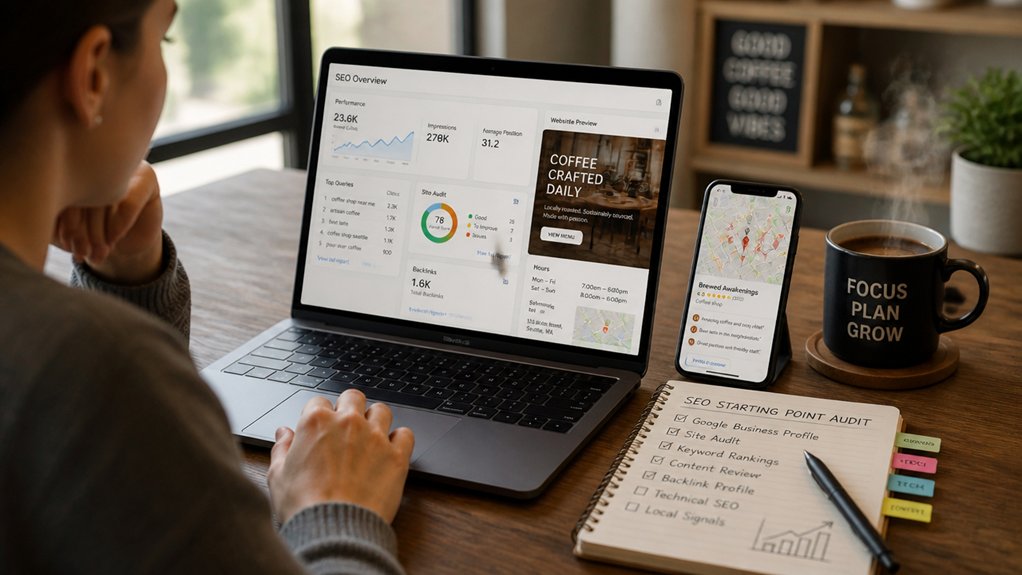
Before you invest time and budget into new keywords or content, you need a clear baseline of how your site performs in UK search today. Pull Google Search Console data for the last 90 days: impressions, clicks, CTR, and average position for your top pages and queries.
In GA4, check organic sessions, engagement rate, and conversions by device, since UK mobile behaviour often differs from desktop.
Run a quick technical scan to spot indexation gaps, broken links, slow Core Web Vitals, and missing metadata.
Review your GBP listing for NAP accuracy, categories, and review velocity.
Add Customer feedback by analysing review themes and on-site search terms to see what visitors can’t find.
Finally, audit Brand consistency across titles, headings, and location pages so users trust you.
Choose SEO Keywords With Buyer Intent
To turn UK search traffic into enquiries, you need keywords that signal a buyer, not a browser—think high-intent modifiers like “near me”, “price”, “quote”, or “book online”.
You’ll get better conversion rates when you map each term to a specific offer and landing page (service, package, or consultation) rather than sending everyone to your homepage.
Prioritise bottom-funnel queries that match how customers buy in the UK, and you’ll attract fewer clicks but more leads.
Target High-Intent Modifiers
Although high-volume keywords can look tempting, high-intent modifiers (like “buy”, “price”, “quote”, “near me”, “same-day”, and “best” + a UK location) usually attract people who are ready to act, not just browse. Prioritise them to lift conversion rates, not just traffic.
In the UK, searchers often add city or postcode signals, so test “best boiler repair Manchester” or “same-day locksmith SW1”. Use Google Search Console to spot queries with strong CTR and low average position, then refine titles and headings around those modifiers.
Optimise for Voice search by matching natural questions like “who can fix my boiler today near Leeds?”. Reinforce the same phrases on Social media profiles and posts to keep wording consistent across touchpoints and improve recall.
Map Keywords To Offers
High-intent modifiers work best when you match each query to a specific service, product, or landing page, so the searcher lands on exactly what they asked for. Use keyword mapping to connect “emergency plumber Leeds” to your call-out page, and “boiler service price Manchester” to your pricing page, not your homepage.
This offer alignment reduces pogo-sticking and lifts conversions because users don’t hunt for next steps. Build a simple UK-focused map: keyword, intent, location, target URL, and primary CTA (call, quote, booking).
Then check Search Console: if a page ranks for mixed intents, split it into dedicated pages and refine titles, H1s, and internal links. Keep one main offer per page, and track leads by URL in GA4.
Prioritize Bottom-Funnel Queries
When you prioritise bottom‑funnel queries, you attract searchers who are ready to buy, not just browse. Target terms like “book”, “quote”, “near me”, “price”, “installation”, and “same‑day” alongside UK geo modifiers (London, Leeds, “nationwide”) to match high‑intent sessions.
Use Search Console to filter queries with strong CTR and conversions, then build landing pages that answer decision questions: costs, turnaround, warranties, reviews, and delivery. Add clear calls to action, trust signals (UK phone number, VAT, returns), and schema for ratings and FAQs.
Improve Customer engagement by aligning copy with what shoppers compare. Use content personalization to show the right offer by location, device, or service tier, and reduce drop‑offs.
Turn Customer Questions Into SEO Content
You can turn real customer questions into SEO wins by mining your Search Console query data and spotting the exact terms UK shoppers use before they buy.
You then publish keyword-rich answer pages that match those queries and capture long-tail traffic with clear, fast solutions.
Finally, you repurpose support chat logs into FAQs and how-to content, so you scale pages around proven pain points instead of guesswork.
Mine Search Query Data
One of the fastest ways to find SEO topics that actually convert is to mine your search query data for the exact questions people type before they buy.
Start in Google Search Console and filter queries that include “how”, “best”, “cost”, “near me”, and UK terms like “postcode”, “VAT”, or “next-day delivery”.
Export 90 days of data and sort by impressions to spot rising Keyword trends, then check clicks and CTR to see what’s already resonating.
Layer in Search volume from Google Ads Keyword Planner to validate demand beyond your site.
Cross-check with your internal site search, live chat transcripts, and call notes for phrasing customers actually use.
Prioritise questions with high intent and low competition locally.
Build Keyword-Rich Answer Pages
Search query data gives you the wording; answer pages turn that wording into rankings and leads. Build one page per high-intent question you see in Google Search Console, focusing on UK phrasing (e.g., “cost in GBP”, “near me”, “VAT included”). Put the exact question in the H1, answer it in the first 40–60 words, then add scannable sections: steps, pricing ranges, delivery/returns, and local trust signals like service areas and UK phone hours. Use schema (FAQPage or HowTo) to win richer results and lift CTR. Apply Content personalization by tailoring examples to industries or regions you serve. Drive Social media engagement by posting the same Q&A as short clips linking back to the page.
Repurpose Support Chat Logs
Because your support chat already captures the exact wording people use when they’re ready to buy (or about to churn), it’s one of the fastest UK-friendly sources of SEO topics you can publish with confidence.
Export chat logs, then cluster repeat questions by intent: delivery times, returns, sizing, invoicing, GDPR, and local availability across the UK.
Turn each cluster into an FAQ or short guide that answers in plain English, adds pricing or policy specifics, and links to relevant products.
Use the exact phrases customers type in Chat support as H2s and meta titles, so you match real search terms.
Track volume: if 20+ chats ask the same thing monthly, you’ve found a high-value page.
Finally, train Customer service to tag chats by topic, so your content pipeline stays accurate and current.
Place Keywords in Titles, URLs, and Headings
When you place your target keywords in key on-page elements, you help both Google and UK customers understand exactly what you offer within seconds.
Start with Keyword research: pick one primary phrase per page based on UK search intent (e.g., “emergency plumber Bristol” vs “plumber”). Put it near the front of your title tag, keep titles under ~60 characters, and write them for clicks, not just rankings.
Use short, readable URLs that include the keyword and location, like /bristol-emergency-plumber/, and avoid dates or random parameters.
Structure headings so your H1 mirrors the core query, while H2s cover related needs (pricing, turnaround, areas served). This supports content marketing by aligning page structure with questions people actually ask.
Track CTR and rankings in Search Console monthly.
Fix On-Page SEO on Your Top Pages

Start with your highest-traffic UK pages in Search Console, then tighten your title tags and meta descriptions so they match intent and lift click-through rate.
Keep titles unique, front-load primary keywords, and use clear benefits and location cues where relevant.
Next, strengthen internal linking from related pages using descriptive anchors to pass authority and help users reach key services faster.
Optimize Titles And Meta
Although Google’s snippets don’t always pull directly from your metadata, well-optimised titles and meta descriptions still drive higher click-through rates—so they’re one of the fastest on-page fixes you can make on your top UK landing pages.
Start with Title optimization: keep titles ~50–60 characters, lead with the primary query, and add a UK trust cue (e.g., “London”, “UK-wide”, “VAT-inclusive”). Match intent—“buy”, “book”, “price”, or “near me”—so searchers feel you’ve got the exact answer.
For each page, write one compelling Meta description (120–155 characters) that mirrors the offer, includes a clear benefit, and ends with a specific call to action.
Use Search Console CTR data to spot underperforming pages, then A/B test wording monthly and prioritise high-impression queries first.
Improve Internal Linking
Where do most small business pages lose easy rankings on Google UK—right inside their own site structure. If your best service or product pages sit three or more clicks deep, Googlebot and users treat them as lower priority.
Build a clear link hierarchy: homepage → category/service hubs → key pages → supporting FAQs and blogs. Add 3–5 internal links from each high-traffic page to your top conversion pages, and point blog posts back to the relevant hub.
Use descriptive Anchor text that matches intent (“emergency plumber in Leeds”), not “click here”. Keep links above the fold where possible, and avoid orphan pages entirely.
Track improvements in Search Console: look for rising impressions, better crawl stats, and shorter paths in your analytics behaviour flow too.
Improve Site Speed and Indexing (Technical SEO)
Because Google prioritises fast, crawlable pages, you’ll get more value from every piece of content when your site loads quickly and search engines can index it cleanly.
In the UK, slower sites can lose impatient mobile users, so treat Site speed as a revenue lever, not a nice-to-have.
Start with Core Web Vitals in Search Console and PageSpeed Insights. Compress images (WebP), enable server-side caching, and minify CSS/JS.
If you’re on Shopify, WordPress, or Wix, remove heavy apps/plugins and lazy-load below-the-fold media.
Then tackle Indexing issues: submit an XML sitemap, fix robots.txt blocks, and remove accidental “noindex” tags.
Use canonical tags to prevent duplicates, and redirect old URLs with 301s.
Re-crawl key pages after changes, and track improvements weekly.
Add Internal Links That Boost Rankings
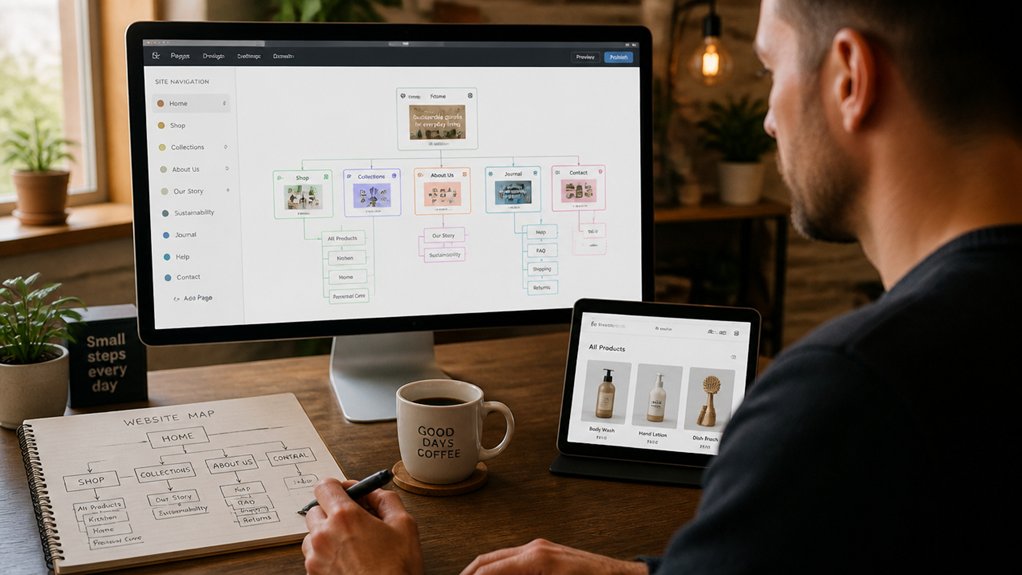
Once your site loads fast and Google can crawl it cleanly, internal linking helps you turn that technical performance into higher rankings by showing search engines which pages matter most.
Link from high-traffic UK pages (check GA4) to priority service and product pages using descriptive anchors, not “click here”. Keep links near the top where users engage, and add 2–5 contextual links per page to strengthen topical clusters.
Refresh older posts with new internal links to signal Content freshness and recirculate authority to updated offers. Use breadcrumbs and a clear hub-and-spoke structure so visitors don’t bounce.
Test on phones: strong Mobile responsiveness means links are tappable, spaced, and easy to follow. Monitor crawl paths in Search Console and fix orphan pages quickly.
Boost Local SEO With Google Business Profile
Although your website does the heavy lifting for rankings, your Google Business Profile often decides whether nearby customers in the UK call you, request directions, or scroll past—especially on “near me” searches where Google prioritises map results.
Claim and verify your listing, then complete every field: primary category, services, opening hours, accessibility, and a UK phone number. Add fresh photos weekly and publish Posts for offers, events, and updates to lift engagement signals.
Drive Customer reviews by asking after purchase and replying within 24 hours; review volume and recency correlate with higher map visibility.
Keep your name, address, and phone identical across directories and Local citations, including postcode formatting, to reduce inconsistency.
Track calls, direction requests, and website clicks in GBP Insights, then refine what’s underperforming.
Get Backlinks With Simple, Targeted Outreach
While Google’s algorithm uses hundreds of signals, quality backlinks still act as a clear trust marker for UK businesses—especially when they come from relevant local sites in your niche. Build them with targeted outreach: list 20 local partners (suppliers, chambers of commerce, trade bodies, neighbourhood blogs) and pitch one specific value, like a guest tip, case study, or data point from your customers.
Prioritise sites with real traffic and topical relevance over high “DA” vanity metrics.
Use Influencer collaborations with micro-creators in your area: offer a product trial or co-made guide, then request a link in the write-up. Pair this with Social media outreach—DM editors after you’ve engaged with their posts—to lift reply rates.
Track wins in a sheet and measure referral visits and enquiries, not links alone.
Avoid the Biggest Small Business SEO Mistakes
If you chase quick wins instead of search intent, you’ll often lose the rankings—and the leads—that matter for a UK small business.
Start by mapping each page to one primary query and a clear next step, then measure outcomes in Search Console: impressions, clicks, and conversions, not just traffic.
Avoid common SEO pitfalls like Keyword stuffing, thin “service + town” pages, and copying supplier text.
Google’s UK SERPs reward usefulness, so answer pricing, availability, delivery areas, and FAQs in plain English.
Don’t ignore technical basics: fix broken internal links, add schema for LocalBusiness, and keep Core Web Vitals in the green.
Finally, stay consistent with your NAP across Google Business Profile, your site, and UK directories to protect local visibility.
Conclusion
Now you’ve got a clear SEO plan: audit your site, target buyer-intent keywords, answer real customer questions, and tighten on-page basics across your top pages. Add smart internal links, keep your Google Business Profile accurate, and earn local UK backlinks through focused outreach. Track results in Search Console and Analytics so you can double down on what lifts impressions, clicks, and calls. Want more local leads without upping ad spend? Keep iterating monthly.
About the Author