
You can’t build an online presence that stands out if you’re trying to speak to everyone. You need a clear niche, a sharp unique value proposition, and a brand identity that stays consistent across your website, social channels, and listings. Then you’ve got to back it with fast, mobile-first pages, focused SEO, and trust signals like reviews. The real advantage comes when you connect these pieces in the right order…
Key Takeaways
- Define a clear niche and audience, then craft a UVP promising a specific result with proof that builds instant trust.
- Build a consistent brand identity—voice, visuals, and messaging—so people recognize you quickly across web, email, and social.
- Create a fast, mobile-first website with simple navigation, strong trust elements, and one primary CTA per page.
- Improve visibility with SEO and local listings, using consistent NAP, location pages, schema markup, and active review management.
- Track conversions and rankings, audit competitors monthly, and update content clusters to match buyer intent and close keyword gaps.
Define Your Audience, Niche, and UVP
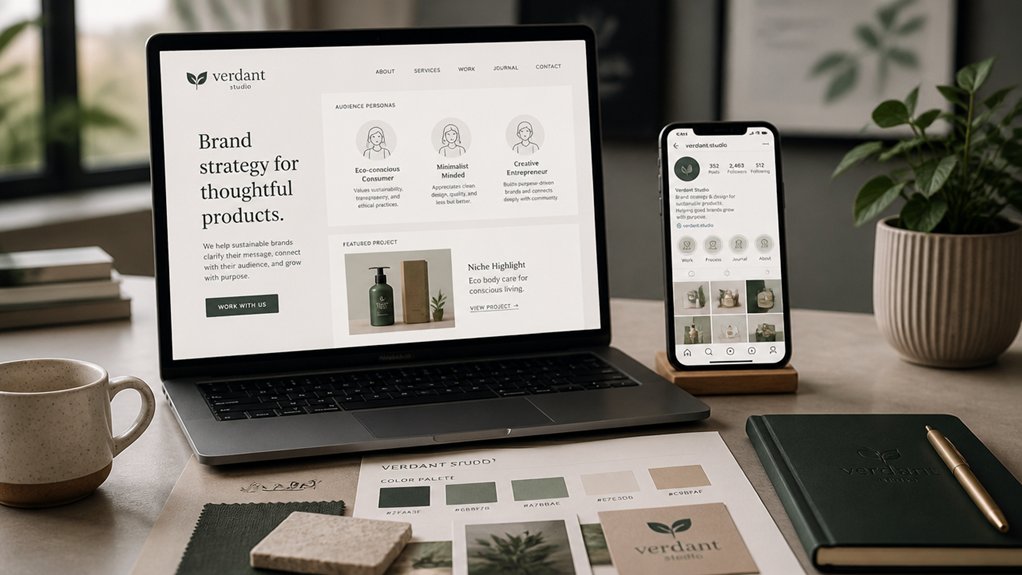
Three decisions shape every part of your online presence: who you serve, what you specialize in, and why you’re the best choice.
Start with Audience targeting: define your ideal customer by industry, role, pain points, buying triggers, and search intent. Use that clarity to choose a niche you can win, not a broad category you can’t defend.
Niche differentiation means you name the specific problem, context, and outcome you deliver better than alternatives.
Then write your UVP as a tight promise: “I help [audience] achieve [result] without [common friction] through [unique approach].”
Validate it with proof: case results, turnaround time, certifications, or proprietary methods.
When your audience, niche, and UVP align, every page ranks clearer and converts faster.
Build a Consistent Online Brand Identity
To build a consistent online brand identity, you’ve got to lock in a clear brand voice and use it in every customer touchpoint.
Align your visual design elements—logo, colors, typography, and imagery—so your business looks instantly recognizable across your website and social media.
Standardize your messaging on every platform so your value stays consistent, boosts trust, and strengthens your online presence.
Define Your Brand Voice
Although your visuals grab attention first, your brand voice keeps people listening—and it should sound the same everywhere you show up online. Define it by choosing 3–5 attributes (clear, bold, helpful, etc.) that match your audience’s expectations and your value proposition.
Then lock in Tone consistency: decide how you greet, explain, persuade, and respond to feedback across your website, email, social posts, and ads.
Drive Voice differentiation by naming what you won’t sound like, and by using signature phrases, preferred vocabulary, and a consistent level of formality. Create a short voice guide with examples of headlines, CTAs, and customer replies so your team writes fast and on-brand.
When your voice stays steady, you build trust, improve recognition, and convert more visitors into loyal customers.
Align Visual Design Elements
Once you’ve locked in your brand voice, your visuals need to reinforce it at a glance across every digital touchpoint. Choose a primary palette and supporting neutrals that create color harmony, then document exact HEX values so your brand looks identical everywhere.
Pair two to three fonts with clear roles—headings, body, accents—to maintain readability and recognition.
Use consistent logo sizing, spacing, and safe zones to prevent distortion, and set rules for icon style, photo treatment, and illustration tone.
Build a strong visual hierarchy with predictable heading levels, button styles, and whitespace so users scan faster and act sooner.
Apply the same design system to your website, landing pages, profiles, and emails, and audit quarterly to catch drift.
Standardize Messaging Across Platforms
When your website, social profiles, ads, and emails all say the same core message, people recognize you faster and trust you sooner. You create Brand consistency by defining a one-sentence value proposition, three proof points, and a clear call to action you reuse everywhere.
Audit every channel and replace mixed promises, tones, and taglines with unified language. Keep your positioning, benefits, and customer outcomes identical, even when formats change.
Use the same keywords your audience searches, and mirror them in headlines, bios, landing pages, and email subject lines. This builds Messaging clarity, boosts click-through rates, and reduces confusion that kills conversions.
Create a simple messaging guide with approved phrases, brand voice rules, and examples, then train your team and review quarterly.
Create a High-Converting Website for Your Online Presence
To turn visitors into leads and sales, you need a conversion-focused website structure that guides people from landing page to checkout with zero friction.
You’ll boost results with clear calls to action that tell users exactly what to do next—and help search engines understand your key pages.
You can’t afford slow load times or a clunky mobile experience, so prioritize speed and mobile performance to protect rankings and conversions.
Conversion-Focused Site Structure
Although your brand story matters, your website’s structure determines whether visitors convert or bounce. Build a logical hierarchy that mirrors search intent: Home, Solutions, Industries, Pricing, Resources, and Contact.
Keep navigation shallow so key pages sit within two clicks, and use descriptive labels that match high-value keywords. Strengthen internal linking with topic clusters that guide readers from awareness content to decision pages without dead ends.
Improve user engagement by prioritizing scannable layouts, consistent headings, and fast-loading media. Reduce friction with clear paths for first-time visitors and returning customers, which supports customer retention.
Add trust-building elements within the flow—reviews, certifications, FAQs, and case studies—so prospects find proof exactly when they need it. Make every page answer “what’s next?” through structure alone.
Clear Calls To Action
Because your visitors won’t guess what you want them to do next, your website needs clear calls to action that guide every click toward a conversion. Place one primary CTA per page, aligned with the user’s intent: “Book a Consultation,” “Get a Quote,” or “Start Free Trial.” Use benefit-driven copy, strong verbs, and high-contrast buttons that look clickable.
Keep forms short, reduce choice overload, and reinforce trust with microcopy like “No spam” or “Cancel anytime.” Repeat the same call to action at natural decision points—hero section, mid-page proof, and closing—so users don’t have to hunt for it.
Support clicks with engagement strategies such as testimonials near CTAs, FAQ expanders, and exit-intent offers that capture leads without distracting from the goal.
Speed And Mobile Performance
When your site loads fast and works flawlessly on mobile, you keep visitors engaged and turn more clicks into leads. Page speed is a direct ranking and conversion factor, so you can’t treat it as optional. Compress images, enable browser caching, and minify CSS/JS to cut load time.
Use a reliable hosting plan and a CDN to reduce latency for every visitor.
Mobile optimization matters just as much because most users browse on phones. You should use responsive layouts, readable font sizes, and tap-friendly buttons, then test across devices.
Keep forms short, reduce pop-ups, and prioritize above-the-fold content so visitors can act quickly. Track Core Web Vitals in Search Console, fix slow pages, and you’ll earn better visibility, lower bounce rates, and more inquiries.
Strengthen Your Online Presence in Search, Maps, and Directories
How easily can customers find you the moment they search—on Google, in Maps, or across local directories? You control that answer by tightening Local SEO signals and keeping your business data consistent everywhere it appears.
Start with Google My Business: claim it, verify it, choose the right categories, add services, hours, photos, and accessibility details, then keep updates current.
Align your NAP (name, address, phone) across Yelp, Apple Business Connect, Bing Places, and industry directories to prevent ranking dilution and customer confusion.
Add location pages that match real service areas, embed a map, and use schema markup so search engines trust your details.
Encourage reviews and respond quickly to build relevance, authority, and conversions.
Track calls, direction requests, and queries to refine.
Publish Content That Grows Your Online Presence

Accurate listings and strong Local SEO make you discoverable, but content makes you memorable and keeps you showing up for new searches. Publish pages and posts that answer real buyer questions, target long-tail keywords, and match search intent. Build topical clusters around your core services, then link them to key location and service pages to strengthen relevance.
Use Content diversification to expand reach: how-to articles, short videos, FAQs, comparison guides, downloadable checklists, and case-focused insights. Repurpose each asset across your website, Google Business Profile updates, and social channels with consistent messaging.
Prioritize audience engagement by inviting questions, using clear calls to action, and updating evergreen pages with fresh data. Track rankings, clicks, and conversions, then double down on formats and topics that perform best over time.
Use Reviews to Build Trust in Your Online Presence
Although your website and content explain what you do, reviews prove it with real customer outcomes—and they’re a major trust signal for both search engines and buyers. Make it easy for customers to leave feedback on Google Business Profile, industry directories, and your website. Then showcase top ratings where prospects decide: service pages, product pages, and checkout.
Strengthen credibility with Customer testimonials that name the problem, your solution, and the result. Ask for specific details, photos, or before-and-after notes to increase authenticity and conversion.
Use review management to respond quickly, thank happy customers, and address concerns without defensiveness. When you resolve issues publicly and professionally, you show reliability and reduce buyer risk.
Keep your business info consistent across platforms so reviews reinforce the same brand and location signals.
Measure What Works and Improve Your Online Presence

Once you’ve built trust with a strong website, content, and reviews, you need data to keep your online presence growing. Set up analytics tracking to monitor organic traffic, conversions, bounce rate, and top landing pages. Tie every metric to a goal: calls, bookings, form fills, or sales.
Then test improvements—headline updates, faster load times, clearer CTAs—and measure lift.
Run monthly competitor analysis to see where rivals outrank you, what keywords they target, and which content earns links. Use those insights to refine your SEO strategy, expand service pages, and publish answers to high-intent questions.
Review Google Business Profile insights to optimize photos, posts, and categories. Finally, report results in a simple dashboard so you can spot trends early and keep iterating.
Conclusion
When you define your audience and UVP, your online presence stops blending in and starts converting. Keep your brand identity consistent, build a fast mobile-first website, and use clear CTAs to guide every click. Strengthen visibility with local SEO, accurate listings, and fresh content that answers real searches. Reviews add proof and reduce friction. Track rankings, traffic, and conversions, then refine what works. Your strategy becomes a lighthouse, not noise, in a crowded market.
About the Author