
If you want an online presence that attracts the right customers, you’ve got to start with clear targeting and consistent signals. You define your ideal buyer, then you align your website, profiles, and offers so search engines and prospects see one story. You use high-intent keywords, proof points, and CTAs that qualify leads, not just generate clicks. Most businesses skip one step here, and that’s where the wrong inquiries begin…
Key Takeaways
- Define ideal customer personas and segments, using CRM, search, and support data to match messaging to real intent.
- State minimum budget, timelines, and non-negotiables to repel poor-fit prospects and attract qualified leads.
- Audit your website, Google Business Profile, and listings for consistent service names, offers, NAP data, reviews, and visuals.
- Align landing pages, profiles, and CTAs around one core promise, linking each channel to a canonical service page.
- Publish qualification content—pricing, “who it’s for/not for,” and comparisons—targeted to high-intent keywords and tracked with analytics.
Define Your Ideal Customer (and Who to Repel)

Before you build your online presence, you need to define exactly who you’re trying to attract—and just as importantly, who you’re willing to turn away—because targeted messaging consistently drives higher engagement, better-qualified leads, and stronger conversion rates.
Start by building Customer personas from real inputs: CRM data, search queries, win/loss notes, and support tickets.
Then apply Market segmentation by budget, urgency, industry, and buying role so your pages match intent.
You’ll repel poor-fit prospects by stating minimum engagement size, exclusions, timelines, and non-negotiables in plain language.
Use SEO terms your best customers actually type, and map them to specific pain points and outcomes.
When you align headlines, offers, and calls-to-action to one ideal segment, you reduce bounce rates and boost booked calls.
Audit Your Online Presence for Mixed Signals
If your website, social profiles, and directory listings don’t tell the same story, you’ll leak qualified traffic and confuse buyers at the exact moment they’re comparing options. Start with a quick inventory: your top-ranking pages, Google Business Profile, LinkedIn, Instagram, and the directories that show up for your branded search.
Then audit for mixed signals that hurt SEO and conversions: mismatched service names, outdated offers, inconsistent NAP data, conflicting reviews, and tone shifts between channels. Check Brand consistency in your value proposition, proof points, and terminology.
Evaluate Visual branding too—logos, colors, headshots, and imagery style—because recognition drives click-through and trust. Use Search Console and analytics to flag high-exit pages and low-CTR listings; those gaps often reveal the exact messaging that’s costing you leads.
Align Your Website, Profiles, and Offers
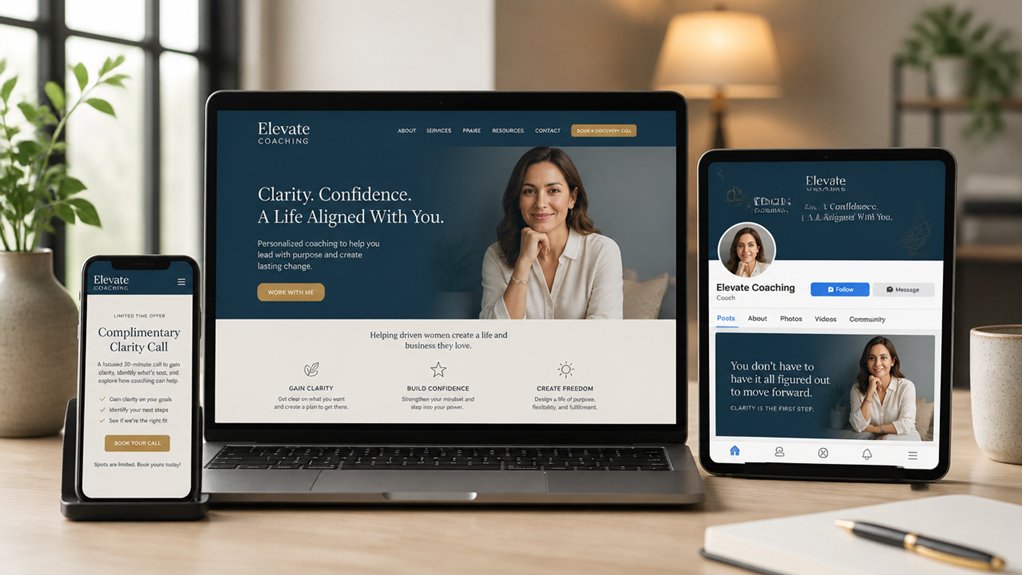
Where do prospects land first—your website, Google Business Profile, LinkedIn, or a directory listing—and do they see the same offer in each place? If not, you’re leaking conversions: inconsistent offers can raise bounce rates and lower lead form completion.
Align your core promise, primary CTA, pricing anchors, and service names everywhere, then track results in GA4 and Search Console.
Lock in Brand consistency by standardizing NAP data, categories, hours, and review prompts across profiles. Strengthen Visual branding with the same logo, colors, image style, and headline layout so recognition happens in seconds.
Match each page and profile to the same target keywords and locations, and link back to one canonical service page. When every touchpoint reinforces one offer, you earn trust faster and qualify better leads.
Write a Brand Voice That Attracts Best-Fit Buyers
Consistent offers and visuals get prospects to click, but your brand voice determines whether they trust you enough to book. Define who you help, what outcomes you deliver, and what you won’t compromise on, then translate it into repeatable language patterns.
Prioritize Tone consistency across your homepage, service pages, emails, and social bios so buyers experience one clear signal. Use client language pulled from calls, reviews, and search queries to boost relevance for SEO and reduce bounce rates.
Your Brand personality should sound like the experience: direct for decisive buyers, reassuring for high-stakes decisions, or analytical for technical services. Replace vague claims with specific proof words—metrics, timelines, process steps—so best-fit customers self-identify quickly.
Keep a short voice guide and enforce it weekly.
Create Content That Pre-Qualifies Leads

To pre-qualify leads, you’ll define ideal buyer signals—industry, budget range, timeline, and pain points—then map them to high-intent keywords your best-fit clients actually search.
You’ll publish filtering content pieces like pricing pages, “who it’s for/not for” guides, and comparison posts that set expectations and reduce unqualified inquiries.
As you track CTR, time on page, and conversion rate, you’ll refine topics and CTAs so more of your traffic turns into sales-ready leads.
Define Ideal Buyer Signals
Even if your website traffic climbs, you won’t convert the right leads until you define the signals that indicate someone can buy, needs your solution now, and fits your delivery model.
Start with Market segmentation: industry, company size, tech stack, geography, and compliance needs.
Then map Buyer behavior to intent stages using analytics: repeat visits to pricing or implementation pages, time-on-page thresholds, demo-request clicks, comparison searches, and return frequency within 7–14 days.
Add firmographic and operational qualifiers: budget ownership, decision timeline, internal resources, and required integrations.
Use CRM fields and form questions to capture these signals consistently, then score them against closed-won data to validate accuracy.
When you refine signals quarterly, you reduce unqualified calls and improve conversion rate without increasing ad spend.
Publish Filtering Content Pieces
Why let unqualified prospects flood your inbox when a few targeted content pieces can filter them out before they ever click “Book a demo”? Publish assets that state who you serve, what results you deliver, and what disqualifies a fit.
Use SEO pages like “Best for” and “Not for” guides, pricing explainers, and implementation checklists that require real commitment. Tie each piece to intent keywords, then add clear next steps: “If you have X budget, Y timeline, and Z tech stack, apply.”
Track scroll depth, CTR, and form completion to confirm quality lift. Pair content curation with audience segmentation: create versions for industries, roles, and maturity levels.
You’ll attract fewer leads, but higher close rates and shorter sales cycles.
Get Found With SEO + Google Business Profile
How do customers find you when they’re ready to buy—especially on Google? You win those moments by pairing on-page SEO with a fully optimized Google Business Profile.
Start with Keyword strategies based on search intent: map high-converting terms to service pages, locations, and FAQs. Then write clear titles, headers, and meta descriptions that match what buyers type.
Strengthen Local visibility by aligning your NAP across directories, adding service areas, and choosing precise categories.
Publish location-specific pages with unique proof points, not duplicated templates. Add photos, products/services, and Q&A to your profile to increase engagement signals.
Track performance with Search Console and GBP Insights: impressions, calls, direction requests, and top queries.
Then refine pages and listings monthly to keep rankings compounding.
Use Reviews and CTAs to Convert the Right Leads
When your prospects compare options side by side, reviews and clear calls-to-action (CTAs) decide whether they contact you or bounce. You should showcase Customer testimonials that match your ideal buyer: industry, problem, timeline, and measurable results. Add star ratings, before-and-after metrics, and reviewer locations to strengthen local SEO and trust signals.
Place CTAs where intent peaks: service pages, pricing, and blog conclusions. Use Call to action strategies that qualify leads, like “Book a 15-minute fit call” or “Get a quote for projects over $5k.” Pair each CTA with proof nearby: a relevant testimonial, badge, or case study snippet.
Track click-through and form completion rates, then A/B test CTA copy, button color, and fields to lift conversions and reduce low-fit inquiries.
Conclusion
When you define your ideal customer, remove mixed signals, and align every touchpoint, you turn your online presence into a laser, not a lantern. You’ll attract buyers who match your value, budgets, and timelines—and filter out the rest. Use SEO and Google Business Profile data to track impressions, clicks, and calls, then double down on what converts. Pair reviews with clear CTAs, and you’ll turn qualified traffic into consistent, best-fit leads.
About the Author