
When a local plumber in Austin shows up first on Google Maps with 200 five-star reviews, you’re likely to call them, not the company you’ve never heard of. That’s what a strong online presence does: it puts you in front of high-intent customers, builds trust fast, and shortens the path to purchase. If your website, listings, and reviews aren’t working together, you’re leaking demand—so what should you fix first?
Key Takeaways
- Customers search online first; a strong presence ensures you’re visible for brand, product, and “near me” queries.
- Optimized listings and consistent NAP data improve local rankings, calls, directions requests, and in-store visits.
- Reviews, photos, and trust signals build credibility and reduce purchase hesitation.
- A fast, mobile-friendly website turns traffic into leads with clear calls-to-action and intent-matched content.
- Analytics reveal what’s working, letting you refine SEO, content, and ads to improve conversions and lower cost per lead.
Define What “Online Presence” Includes

Although many people equate “online presence” with having a website, it actually includes every digital touchpoint where customers can find, evaluate, and contact your business—your site and SEO visibility, Google Business Profile and maps listings, social media profiles, online reviews and ratings, content (blogs, videos, FAQs), paid ads, email marketing, and even how consistently your name, address, and phone number appear across directories.
Each touchpoint shapes your digital footprint and influences how search engines rank you and how prospects decide. You don’t just publish pages; you signal relevance through keywords, structured data, fresh content, and consistent NAP citations.
You don’t just “post”; you build online branding with messaging, visuals, and proof from reviews. When these elements align, customers find answers faster, trust you sooner, and convert with less friction.
Audit Your Online Presence (Quick Checklist)
Before you spend more on SEO, ads, or content, run a fast audit to see what customers and search engines actually experience when they look you up.
Start with Google: search your brand name, product, and “near me,” then note whether your site, profiles, and reviews dominate page one.
Check Brand consistency: logo, business name, address, phone, hours, and messaging should match across your website, Google Business Profile, social platforms, and directories.
Test your site on mobile: load time, broken links, core pages, and clear calls-to-action.
Review analytics: top landing pages, bounce rate, conversion paths, and search queries driving impressions.
Scan reputation: rating averages, response rate, and recency of reviews.
Finally, assess Customer engagement: post frequency, comment response time, and message handling.
Document gaps, prioritize by impact and effort.
Improve Online Presence So Customers Find You
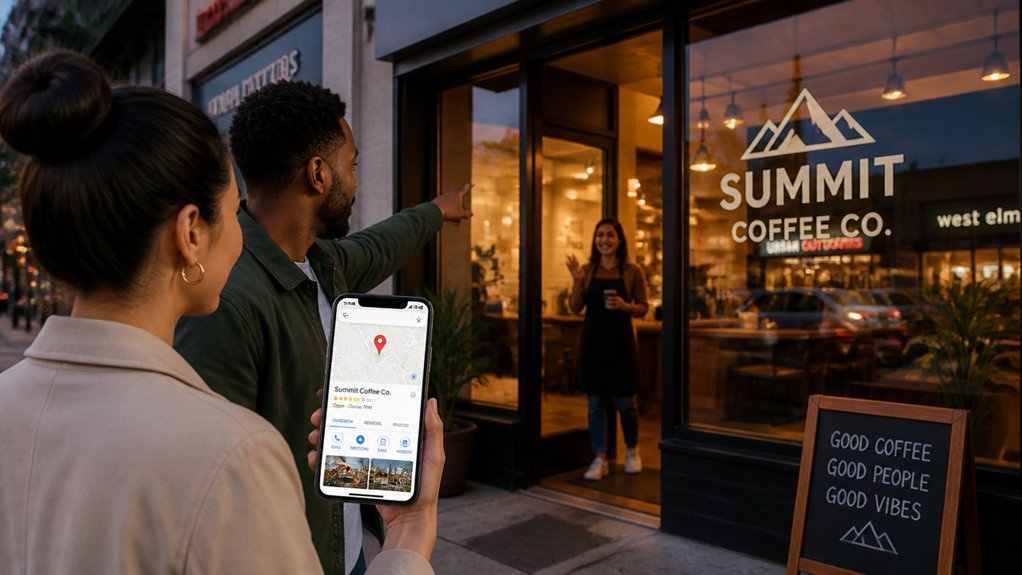
To get found when people search, you’ve got to strengthen your search visibility with targeted keywords, fast pages, and content that matches real customer intent.
You’ll also optimize local listings (Google Business Profile, Apple Maps, and key directories) so your hours, location, and services stay consistent and rank higher in “near me” results.
When you align SEO and local signals, you attract higher-intent traffic and turn more searches into calls, visits, and sales.
Strengthen Search Visibility
Three out of four buyers start with a search engine, so if you don’t rank where they’re looking, you’re invisible at the exact moment intent is highest.
To win that click, you need pages that match search intent, load fast, and answer questions in seconds.
Target high-value keywords with clear headings, schema markup, and internal links that guide visitors to next steps.
Publish consistent, helpful content that earns backlinks and builds topical authority over time.
Protect your Digital reputation by monitoring branded queries, improving review sentiment through better experiences, and publishing trust signals like case studies and FAQs.
Boost Social engagement to amplify reach, drive mentions, and generate link-worthy visibility signals.
Track impressions, CTR, and conversions in Search Console and analytics, then refine titles, snippets, and content gaps weekly.
Optimize Local Listings
High rankings help, but local buyers often choose from the map pack, not the blue links. To win those clicks, you need accurate, complete local listings across Google Business Profile, Apple Maps, Bing, and key directories. Match your name, address, phone, categories, and hours everywhere to protect Brand consistency and reduce ranking confusion.
Add photos, services, attributes, and FAQs so searchers get answers fast and convert without bouncing.
You should post updates and respond to reviews within 24–48 hours; that activity signals relevance and drives Customer engagement. Track calls, direction requests, website clicks, and “discovery” queries to see what’s working.
Fix duplicates, choose location-specific keywords, and keep seasonal hours current. When your listing data stays clean, proximity searches find you, and local intent turns into revenue.
Build Trust Fast With Reviews and Social Proof
Because most buyers research before they reach out, your reviews and social proof often make the first impression—and they can determine whether you earn the click or lose the lead. Strong star ratings and recent feedback signal reliability to both people and search engines, helping you stand out in crowded local results.
Ask satisfied customers for detailed, keyword-rich Customer testimonials that mention outcomes, service types, and locations. Respond to every review fast, thank positive reviewers, and resolve issues publicly to show accountability.
Share case wins, before-and-after photos, and UGC to boost social media engagement, then pin top comments as proof.
Track review velocity, average rating, and sentiment trends monthly, and test different requests to improve conversion. When trust rises, inquiries follow—and your acquisition costs drop.
Make Your Website Your Online Home Base

Your website should be your online home base because it boosts brand credibility and gives search engines a single, authoritative source to rank.
You can centralize content, offers, and updates there, so customers always find accurate info and you control the narrative.
When you optimize pages for speed, clear messaging, and strong calls-to-action, you’ll convert more visitors into leads and sales.
Establish Brand Credibility
While social media profiles can boost visibility, a well-built website does the heavy lifting for brand credibility by giving customers a reliable place to verify who you are, what you offer, and how to reach you.
Add trust signals that users and search engines look for: HTTPS, clear contact info, reviews, awards, and schema markup for Organization and LocalBusiness.
Publish a focused About page that uses brand storytelling to explain your mission, expertise, and proof points in plain language.
Create dedicated landing pages for services so queries match intent and improve rankings.
Showcase influencer collaborations with documented results, disclosures, and links that validate authenticity.
Keep navigation simple, speed fast, and CTAs obvious so visitors don’t bounce—UX metrics correlate with conversions.
Include consistent NAP details to reinforce local trust.
Centralize Content And Updates
Brand credibility gets people to trust you; a centralized website keeps them coming back. Make your site the single source of truth for products, hours, policies, and announcements, then syndicate outward to social and email. This protects Content consistency and reduces customer confusion when platforms change layouts or restrict reach.
Search engines reward fresh, structured information. When you control update frequency—posting new FAQs, blog notes, and release updates—you create more indexable pages, stronger internal linking, and clearer topical signals. Pair every update with descriptive titles, schema where relevant, and consistent NAP details so local and mobile searches find you fast.
Centralization also improves usability: users get one bookmark, one navigation, and one place to verify details before they contact you.
Optimize For Conversions
Even if social media drives the first click, conversions usually happen on a site you control, so treat your website as the home base designed to turn visits into leads, sales, and calls.
Map pages to intent: service pages for high-intent queries, FAQs for long-tail SEO, and clear CTAs above the fold.
Improve speed and mobile UX to reduce bounce rates and protect rankings.
Use trust signals—reviews, guarantees, security badges—near forms and checkout to lift completion.
Track events in analytics, run A/B tests on headlines, buttons, and forms, and iterate based on conversion rate and cost per lead.
Strengthen customer engagement with live chat, tailored offers, and helpful microcopy.
Support brand storytelling with case studies, results, and proof points that move visitors to act.
Boost Online Presence With Accurate Local Listings
Because local intent drives a large share of high-converting searches, accurate local listings can directly increase your visibility where it matters most—Google Search and Maps. When your name, address, phone, hours, and categories match everywhere, you send stronger trust signals to Google and reduce friction for customers ready to buy.
Start by auditing Google Business Profile, Apple Business Connect, Bing Places, and major data aggregators. Fix duplicates, update holiday hours, add services, and choose the most specific primary category. Use consistent UTM-tagged links so you can measure calls, direction requests, and site visits by source.
Encourage fresh reviews and respond quickly; review velocity and owner responses correlate with higher local pack placement. With accurate listings supporting local SEO, you’ll win more “near me” clicks and in-store visits.
Create Content That Grows Online Visibility
Accurate local listings help customers find you on Maps, but content is what keeps you showing up across more searches—and earning the click. You’ll grow visibility by publishing pages that answer real queries: service explainers, FAQs, comparison guides, and location-specific insights.
Use Search Console and keyword tools to map topics to intent and prioritize terms with achievable difficulty and clear demand.
Practice Content diversification: pair evergreen articles with short videos, images, and structured data so you can appear in web, image, and “People also ask” results.
Apply audience segmentation by tailoring content for homeowners vs. contractors, beginners vs. experts, or different neighborhoods.
Optimize titles, headings, internal links, and schema, and refresh outdated pages to sustain rankings.
Convert Online Presence Into Leads and Sales
Once your pages rank and attract qualified traffic, you need to turn those visits into measurable actions—calls, bookings, form fills, and purchases. Align each landing page to search intent, then remove friction with fast load times, scannable layouts, and trust signals like reviews, guarantees, and clear policies.
Match headlines and offers to your target audience, and reinforce brand positioning with consistent messaging, pricing clarity, and benefit-led copy. Use single-goal CTAs, prominent phone buttons, short forms, and live chat to capture high-intent users.
Add internal links from informational posts to commercial pages, and include schema for products, FAQs, and local services to improve SERP click-through.
Retarget visitors with tailored ads and email sequences, then guide them to the next step.
Measure Online Presence With Monthly KPIs
Generating calls, bookings, and purchases is the goal, but you won’t know what’s really working until you track it with monthly KPIs.
Start with organic sessions, keyword rankings, click-through rate, and local pack visibility to measure SEO traction.
Pair that with conversion rate, cost per lead, and call-to-form ratio to confirm revenue impact.
Monitor bounce rate, time on page, and top landing pages so you can improve user journeys and content relevance.
Audit Brand consistency by tracking review ratings, NAP accuracy, and messaging across listings and social profiles.
Add Competitor analysis: compare share of voice, backlink growth, and review velocity to spot gaps you can win.
Review trends monthly, set targets, and act on the data fast.
Conclusion
You can’t afford to treat your online presence as optional—it’s your digital storefront, referral engine, and credibility check in one. When you audit listings, tighten SEO, publish helpful content, and showcase reviews, you help customers find you faster and trust you sooner. Think of it as your business’s GPS: without it, buyers get lost and choose competitors. Track monthly KPIs like traffic, rankings, CTR, leads, and calls, then keep optimizing.
About the Author