Skip the random tactics and pick 2–3 trackable goals (qualified leads, booked calls, sales) with a KPI like cost per lead. Lock down your Google Business Profile, match your site’s NAP and services, and ask for reviews after every win. Publish FAQ content that answers pricing and timeline questions, then add a simple “get a quote” CTA. Follow up fast with segmented emails. Run tightly targeted ads to focused landing pages—then optimize weekly. Keep going and you’ll see the exact playbook.
Key Takeaways
- Set 2–3 measurable goals (leads, booked calls, sales) and review performance weekly to double down on what converts.
- Optimize your Google Business Profile and match your website NAP, services, and keywords to win more local searches.
- Publish FAQ and case-study content that answers buyer questions on cost, timeline, and outcomes, then add clear “get a quote” CTAs.
- Follow up fast and segment leads by behavior, using automated sequences with one clear CTA to lift conversions.
- Run targeted ads to dedicated landing pages, A/B test one change weekly, and showcase reviews and trust badges to boost credibility.
Choose 2–3 Trackable Small Business Marketing Goals

Before you spend another dollar (or late night) on online marketing, lock in 2–3 goals you can actually measure—because “more visibility” won’t pay your rent. Pick targets tied to revenue: monthly qualified leads, booked calls, or online sales. Add one efficiency metric: cost per lead or conversion rate, so you’ll know if you’re buying growth or just expensive clicks.
Next, do quick competitor analysis: what channels bring them reviews, traffic, or offers you can’t ignore? Don’t copy—benchmark. Then set Budget allocation by goal, not vibes: 60% to your best-performing channel, 30% to a promising test, 10% to experiments you can kill fast. Review weekly, tweak ruthlessly, and celebrate numbers, not noise.
Win Local Customers With Google Business Profile + SEO
Now that you’ve got 2–3 trackable goals, aim them where high-intent customers already search: Google. Set up (or fix) your Google Business Profile so it actually sells: correct categories, services, hours, photos, and a call-first phone number.
Then match your website SEO to it—same NAP, same service areas, same keywords—so Google trusts you.
Chase Local visibility with proof, not vibes. Ask for reviews after every win, reply to all of them, and sprinkle your target services into those responses naturally.
Add UTM tags to your profile links so you can see calls, clicks, and direction requests in analytics.
Finally, check Google Maps rankings weekly for your top terms; if you’re not in the 3-pack, you’re basically invisible, like a ninja with rent due.
Small Business Content Ideas That Attract Leads
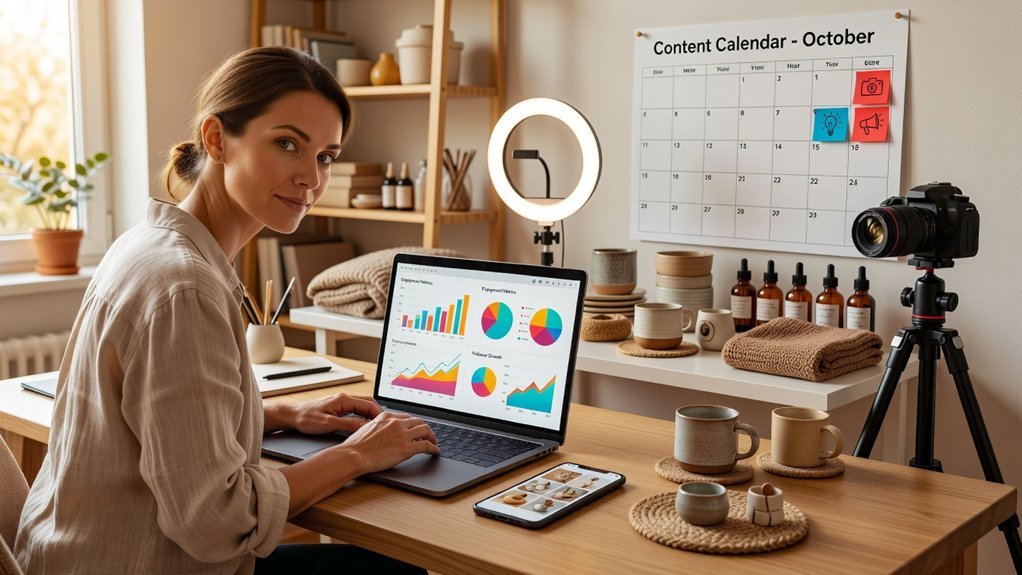
If you want more leads without living on social media, publish content that answers the exact questions your best buyers type right before they call. Start with “cost,” “timeline,” “best vs. worst,” and “what to expect” posts—these convert because they remove uncertainty.
Build a 10-question FAQ hub and link every service page to it; you’ll lift time on site and qualified calls.
Add creative storytelling, but keep it practical: write one mini case study per week with numbers (before/after, hours saved, dollars recovered). Use visual branding to make skimmers stop: one consistent template, bold headers, and annotated photos.
Finish with a simple next step like “check availability” or “get a quote,” not a novel. Track clicks, calls, and form starts.
Email Follow-Ups That Turn Leads Into Customers

Your leads aren’t “cold”—your follow-up is, so segment them by intent and watch reply rates jump.
Then automate timely sequences that hit when interest is highest, not when you finally remember.
Keep every email a clear action play: one goal, one CTA, zero rambling.
Segment Leads By Intent
While every lead lands in your inbox with the same email address field, they don’t show up with the same intent—and treating them that way kills conversions. You need customer segmentation based on behavior, not vibes: pricing-page visits, demo requests, cart abandons, webinar attendance, and “just browsing” content clicks.
Turn that into lead prioritization: high-intent leads get fast, human replies; mid-intent leads get proof (case studies, ROI calculators); low-intent leads get education (guides, checklists).
Add simple rules: if they hit pricing twice in 48 hours, tag “hot”; if they download top-of-funnel content only, tag “research.” Track reply rate, booked calls, and time-to-close by segment, then trim what doesn’t move revenue.
Your inbox becomes a pipeline, not a pile.
Automate Timely Follow-Up Sequences
Intent-based segments give you the “who,” but follow-up timing decides the “when,” and most leads leak out in the gap. Automate sequences so you show up while interest is still warm, not when it’s fossilized.
Start with a rapid first touch within 5 minutes of a form fill, then stagger touches at 1 day, 3 days, and 7 days; response rates typically drop fast after the first hour.
Use behavior triggers—page visits, demo requests, cart abandons—to branch the sequence without extra work.
Bake in Personalized messaging by pulling in the lead’s intent, product viewed, and location, then rotate proof points based on industry.
Track opens, replies, and time-to-response to refine your Timing strategies weekly. Your CRM should chase, not you.
Write Clear Action Emails
Three lines can make or break an email follow-up: the subject, the first sentence, and the call to action. Nail them, and you’ll beat “just checking in” purgatory.
Keep the subject specific (“Your quote for patio doors—2 options”), open with context (“You asked about install timing”), then ask for one action (“Reply with A or B”).
Data backs it: clearer CTAs lift replies, and fewer choices reduce drop-off.
Use personalization strategies that matter—reference their goal, timeframe, or product, not their dog’s name.
Apply email design tips: short paragraphs, bold the deadline, one link max, and a P.S. that restates the ask.
If your email can’t be skimmed in 10 seconds, it’s too long.
Run Small Business Ads With Tight Targeting + Landing Pages
If you’re going to pay for clicks, make those clicks count by pairing tight targeting with a landing page built for one job: conversions. Start with Targeted ads aimed at high-intent searches, tight geo radiuses, and exclusions that cut waste. You don’t need “everyone,” you need “ready now.”
Cap frequency, set a daily budget, and track cost per lead like it’s rent.
Then build Landing pages that match the ad promise word-for-word: one headline, one offer, one form. Strip navigation, ditch stock photos, and add a single CTA above the fold.
A/B test only one variable at a time (headline or button). If your click-through rate rises but leads don’t, your page is the culprit—not the platform. Keep refining weekly.
Get More Reviews and Social Proof That Sell
You can’t scale trust by hoping customers feel chatty, so automate review requests and testimonial capture right after purchase, delivery, or support wins.
Then plaster those trust signals—star ratings, “verified buyer” badges, case-study snippets—across your ads, landing pages, emails, and checkout where they can lift conversion rates, not just egos.
If your proof isn’t visible at the decision point, it’s basically an unpaid intern.
Automate Proof Collection
Because buyers trust other buyers more than your best ad copy, you’ll win more sales by turning reviews and testimonials into an automated, always-on system.
Start at the moment of delight: trigger a review request 24 hours after delivery or service completion, not “sometime later” (aka never). Use SMS or email with one-tap links; shorter forms lift completion rates.
Route unhappy responses to support first, so public ratings don’t become your mistake log.
Add digital verification so platforms flag fakes less and prospects trust the signal more.
Collect customer testimonials with two prompts: “What problem did you have?” and “What changed after?” Store answers in a tagged spreadsheet or CRM field.
Then set a weekly reminder to approve and publish new proof.
Showcase Trust Signals Everywhere
Once you’ve got reviews rolling in, plaster those trust signals everywhere prospects hesitate—product pages, checkout, booking forms, proposals, even your email signature—so they don’t have to hunt for reassurance.
Put star ratings above the fold, and add one punchy Customer testimonials block right next to the “Buy” button.
If you serve locally, embed Google reviews and show your review count; volume beats vibes.
Use Trust badges where risk spikes: payment pages, scheduling, and any “enter card” moment.
Don’t overdo it—three badges max, or you’ll look like a NASCAR.
Rotate proof by intent: case-study snippets for high-ticket pages, quick quotes for low-friction offers.
Track conversion lift with A/B tests; keep what moves revenue, not ego.
Conclusion
You don’t need more marketing “hacks”—you need a scoreboard. Pick 2–3 goals, tighten your Google Business Profile, publish lead-magnet content, follow up by email, run ads that land on focused pages, and stack reviews like receipts. Here’s the kicker: 88% of people trust online reviews as much as personal recommendations. So if you’re not collecting proof, you’re leaving money on the table. Track it, tweak it, repeat—boring beats broke.
About the Author