
Start with a mini audit in Search Console and Analytics to spot pages losing clicks, weak queries, and high-traffic pages that don’t convert. Crawl your site to fix 404s, redirect chains, thin pages, duplicate titles, and indexing issues like “Crawled—currently not indexed.” Map long-tail, intent-matched keywords to core service and local area pages to avoid cannibalization. Improve Core Web Vitals (LCP <2.5s, INP <200ms, CLS <0.1), then strengthen NAP citations, reviews, and local backlinks. Next, you’ll see the highest-impact fixes to prioritize.
Key Takeaways
- Run an SEO audit in Search Console and Analytics to find traffic drops, crawl errors, and low-converting landing pages.
- Fix technical SEO issues: improve Core Web Vitals, remove redirect chains, update sitemaps, and ensure robots/noindex aren’t blocking key pages.
- Research and map keywords by intent to the right pages, prioritizing long-tail terms and avoiding keyword cannibalization.
- Optimize on-page elements: unique titles, one clear H1, scannable H2 sections, and copy that answers queries with strong calls-to-action.
- Strengthen local SEO with a complete Google Business Profile, consistent NAP citations, location pages, reviews, and local backlinks from partners and media.
Find Your Biggest SEO Leaks (Mini Audit)
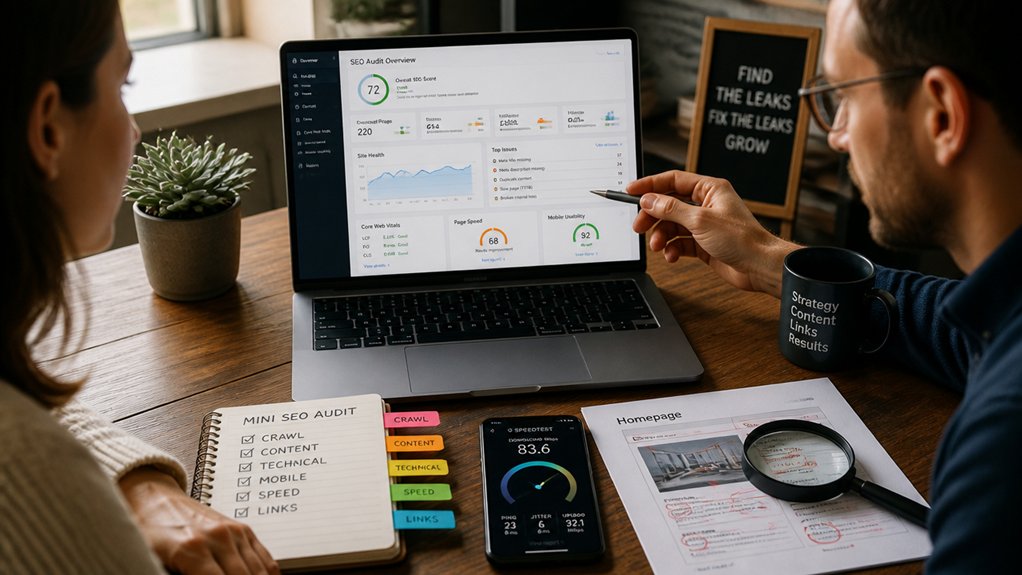
Where are you losing the most organic traffic—and revenue—right now? Run a mini audit in 30 minutes: open Google Search Console and sort pages by clicks lost over the last 28 days. Then check which queries slipped and whether impressions stayed flat (ranking issue) or dropped (demand or indexing).
In Google Analytics, find landing pages with high entrances but low conversion rate; those are money leaks.
Next, crawl your site and flag 404s, redirect chains, thin pages, and missing titles. Test Core Web Vitals; if LCP and INP fail on top pages, you’re paying a speed toll.
Prioritize fixes by impact: Content refresh for declining winners, Design overhaul for UX blockers, then technical cleanup.
Document before/after metrics weekly.
Pick Keywords Customers Actually Search
After you’ve fixed the biggest SEO leaks, you need keywords that match what people type and why they’re typing it.
Start by mapping search intent (buy, compare, fix), then target long-tail phrases that convert because they’re specific and less competitive.
Finally, analyze local queries like “near me” and neighborhood terms so you show up when customers are ready to act in your area.
Identify Search Intent
Most SEO wins start with a simple question: what’s the searcher trying to accomplish? If you match intent, you’ll rank faster and convert more because your page answers the real need behind the query.
Start by sorting target terms into intent buckets: informational (learn), commercial (compare), transactional (buy/book), and navigational (find a brand).
Validate your assumptions with Search behavior signals. Look at the current top results: are they guides, category pages, or service pages? Check SERP features like maps, reviews, and “People also ask” to see what Google thinks users want.
Then align your page: promise the outcome in the title, answer key questions early, and add proof (pricing, FAQs, testimonials) that fits user motivation.
Use Long-Tail Phrases
Because broad keywords are expensive to win and vague to serve, you’ll get faster SEO gains by targeting long-tail phrases your customers actually type—specific, multi-word searches like “emergency plumber in Austin open now” or “best accountant for self-employed in Denver.” These queries usually have lower competition and clearer intent, so they attract fewer but higher-quality clicks that convert.
Build a list from your service pages, FAQs, and customer emails, then expand each core term with modifiers like price, timeframe, problem, brand, and audience. Validate with search volume and difficulty data, but don’t chase volume alone—prioritize phrases that match your offers and margins.
Use Long tail strategies to map one phrase per page and write headings that mirror wording. Add Keyword diversification by targeting several variations that share the same intent, then measure rankings, clicks, and leads monthly.
Analyze Local Queries
Three quick data checks can tell you whether you’re targeting the local searches that actually drive calls: review your Google Business Profile “Queries” report, scan Google Search Console for location-modified terms (city, neighborhood, “near me,” ZIP), and confirm intent by looking at the current map pack results for each phrase.
Prioritize queries with impressions plus steady clicks; they’re already proving demand. Then match each query to a page with clear service + location copy, not a vague homepage. If the map pack shows service pages, build one; if it shows listicles, create a comparison or “best of” angle.
Mine Customer reviews for the exact wording people use (“emergency,” “same-day,” “wheelchair accessible”). Tie in Local events when relevant, like “catering for [festival name].”
Track rank and calls monthly.
Map Keywords to Your Core Service Pages
When you map specific keywords to each core service page, you turn scattered search demand into a focused SEO plan you can execute.
Start with your top revenue services and list the primary query plus 3–5 close variants per page.
Use Keyword mapping to prevent cannibalization, so each page targets one intent, not “everything.”
Put your primary keyword in the title tag, H1, and first 100 words, then support it with related terms in subheads and FAQs.
Keep Core pages aligned to what people actually search: “emergency plumber,” “water heater repair,” “drain cleaning,” not internal jargon.
Review Search Console and rank tracking monthly; if two pages rank for the same term, consolidate or retarget.
This keeps visibility measurable and scalable.
Make Your Site Easy for Google to Crawl

Even if you’ve nailed your keyword mapping, Google can’t rank pages it can’t reliably discover and understand. Start by confirming Googlebot can access your pages: check robots.txt for accidental blocks, keep important pages out of noindex, and make sure your XML sitemap is current and submitted in Search Console.
Next, keep your Site architecture simple and predictable so crawlers don’t waste time. Every extra redirect chain, parameter-heavy page, or duplicate version dilutes your crawl budget. Use canonical tags where duplicates are unavoidable, and standardize to one preferred protocol and hostname (HTTPS, www or non-www).
Finally, monitor crawl stats in Search Console: rising “Crawled – currently not indexed” or server errors signal wasted crawling and missed indexing opportunities.
Clean Up URLs, Menus, and Internal Links
Because Google and your visitors follow links the same way, messy URLs and inconsistent navigation quietly bleed rankings and conversions. Standardize your URL structure: keep it short, lowercase, and readable (e.g., /services/roof-repair/), and remove date strings, random parameters, and duplicate paths. If you change URLs, 301 redirect old pages to the new version so you don’t lose accumulated authority.
Next, tighten your menu design. Put your highest-value pages in the main navigation, limit top-level items, and use clear category groupings so people reach key pages in two clicks.
Then strengthen internal links: link from related pages using descriptive anchors, fix broken links, and avoid orphan pages with zero inbound links. This improves crawl efficiency, distributes equity, and increases conversions.
Optimize Titles, H1s, and On-Page Copy
Your title tag is often the biggest lever for improving clicks from search, so you’ll write keyword-rich titles that match real queries and signal intent fast.
You’ll use one clear H1 per page to lock in the topic and keep your content structure unambiguous for users and crawlers.
Then you’ll tighten on-page copy with specific keywords, stronger headings, and benefit-driven answers that satisfy what searchers actually want.
Craft Keyword-Rich Titles
When you align your title tag, H1, and first-page copy around the same primary keyword, search engines—and readers—understand your page’s topic faster.
Start with keyword research that reflects real demand and intent, then turn it into a title that earns clicks without sounding spammy.
For Title optimization, keep your title near 50–60 characters so it won’t truncate in results.
Put the primary keyword early, add a specific value hook (service + location, price range, or outcome), and avoid duplicate titles across pages.
Use numbers, timeframes, or differentiators only when they’re true.
Match the title to what the page delivers, because misleading titles can raise bounce rates and weaken rankings over time.
Use One Clear H1
One clear H1 signals the page’s main topic in under a second—for both Google and readers. Keep it singular, specific, and aligned with your title tag so search engines don’t see mixed signals.
Pages with multiple competing headings can dilute topical focus and slow scanning, which raises bounce risk. Put your primary keyword in the H1 naturally, near the start when possible, and make it describe the page outcome, not your brand slogan.
Match the H1 to your website aesthetics: strong contrast, readable size, and consistent typography improve comprehension and accessibility.
When you share the page on social media, that same H1 often becomes the on-page anchor visitors verify after the click. If it matches their intent, you keep them engaged and moving deeper.
Strengthen On-Page Copy
Although technical SEO matters, on-page copy still drives rankings and conversions because it tells Google exactly what the page covers and tells visitors exactly what to do next.
Start with a keyword-focused title tag (50–60 characters) that matches search intent and earns clicks. Keep your H1 tight, then use H2s to map the page into scannable sections.
Write for content readability: short paragraphs, concrete benefits, and simple words. Put your primary keyword in the first 100 words, then use natural variations instead of repetition.
Strengthen your visual hierarchy with bullets, bolding for key claims, and clear CTAs near decision points.
Replace vague lines like “We offer solutions” with specifics, proof, and numbers. When you answer common questions on-page, you reduce pogo-sticking and lift time on site.
Publish Local Pages That Answer “Near Me

Why do “near me” searches convert so well? They signal high intent: people want a solution now, close by.
If you don’t publish local pages, you’ll miss that demand. Create one page per service area and make it specific—mention the Neighborhood neighborhoods you serve, your address, hours, and service radius.
Add a short section like “How to find us” that references Local landmarks, parking, and nearby transit stops. Include a map embed, clear calls to action, and local testimonials tied to that area.
Use unique FAQs that match real queries (“Do you service Elmwood on weekends?”).
Track performance in Search Console by page and query, then expand pages that earn impressions but low clicks.
Speed Up Your Site (Core Web Vitals)
If your pages take more than a couple seconds to load, you’ll bleed both rankings and leads—Google’s Core Web Metrics (LCP, INP, and CLS) quantify that slowdown and use it as a real-world quality signal. Aim for LCP under 2.5s, INP under 200ms, and CLS under 0.1 to keep visitors moving.
Start by compressing and properly sizing images, using modern formats, and deferring offscreen media so your Website aesthetics stay sharp without heavy payloads.
Minify CSS/JS, remove unused scripts, and delay third-party tags until after interaction to cut INP lag. Enable caching, use a CDN, and upgrade hosting if server response is the bottleneck.
Monitor real-user data in Search Console and PageSpeed Insights, then fix the worst templates first to lift user engagement fastest.
Fix Mobile UX to Boost Rankings
Fast load times earn you points with Core Web Vitals, but mobile UX is where you keep those visitors from bouncing. If your pages pinch-zoom, shift, or hide key actions, you’ll lose clicks and rankings.
Prioritize Mobile responsiveness: use fluid grids, scalable images, and tap targets at least 48px, with enough spacing to prevent mis-taps. Keep above-the-fold content focused and readable at 16px+ body text.
Improve user engagement by reducing friction in high-intent paths. Put your call button, booking, or checkout in one thumb-friendly flow. Cut form fields, enable autofill, and show inline errors.
Track mobile scroll depth, rage taps, and conversion rate by device; then A/B test navigation labels and sticky CTAs. Mobile-first fixes pay back fast.
Win Local Backlinks and Citations
Local backlinks and consistent citations send strong trust signals to Google, and they often correlate with better map-pack visibility.
You’ll start by listing your business in high-quality directories.
Then you’ll earn links from local media by pitching timely, newsworthy updates.
You’ll also partner with nearby organizations to trade real value for authoritative mentions that move rankings.
List Your Business In Directories
Because Google cross-checks your business info across the web, listing your company in reputable directories can boost local SEO by strengthening citations and earning easy backlinks. Start with your Google Business Profile, then add consistent NAP (name, address, phone) to Bing Places, Apple Business Connect, Yelp, and key industry directories.
Audit for duplicates and fix mismatches—citation consistency correlates with better map visibility.
Choose directories that drive real traffic, not junk links. Complete every field, add photos, categories, services, and hours. Encourage Customer reviews on top platforms and respond quickly; review volume and freshness influence clicks and conversions.
Link your listings to your website and Social media profiles to reinforce brand signals. Recheck quarterly, especially after moves, new numbers, or rebrands.
Earn Links From Local Media
Directory listings help you prove consistency, but local media links help you prove relevance and authority. A single link from a trusted local newsroom can lift referral traffic and strengthen your local ranking signals because Google weighs real-world prominence.
Pitch stories, not ads. Share timely data: a mini survey of customers, a seasonal pricing index, or a neighborhood safety checklist. Tie it to Community engagement and include a clear local angle, spokesperson, and visuals.
Make it easy to cite you by offering a fact sheet with your business name, address, phone, and URL.
After coverage runs, drive Social sharing from your site and channels, and ask the outlet to link to the exact resource page you want to rank. Track placements and traffic in GA4 monthly.
Partner With Nearby Organizations
When you team up with nearby nonprofits, schools, chambers, or events, you can earn backlinks and citations that carry real trust signals.
Target partners with strong domain authority and accurate NAP listings, then offer clear value: expertise, space, discounts, or volunteers.
Prioritize Community collaboration that creates a web page mentioning your business, linking to your site, and listing your address and phone.
Use Local sponsorships strategically: sponsor a 5K, scholarship, or youth league and request placement on the sponsor page, not just a logo on a PDF.
Track impact in Google Search Console by monitoring referral domains and branded queries.
Keep a simple outreach script, follow up, and update partners when your URL or business details change.
Conclusion
You’ve patched the biggest leaks, targeted real search demand, and mapped keywords to pages that convert. You’ve made crawling effortless, cleaned URLs and links, built “near me” pages, and tightened Core Web Vitals and mobile UX—so Google can trust what users already feel. Next comes the part most small businesses skip: earning local citations and backlinks that validate you off-site. Do that, track rankings and leads weekly, and you’ll see the gap close—crucial.
About the Author