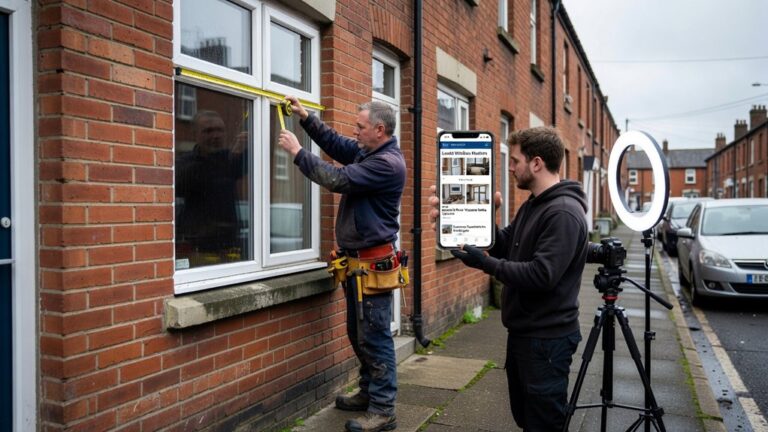

You’ll win UK small-business SEO by getting the fundamentals right: make your site mobile-first and hit Core Web Vitals (LCP under 2.5s on 4G), use HTTPS, tidy URLs, and submit an XML sitemap in Search Console. Optimise your Google Business Profile with matching NAP, correct categories, fresh photos, and review replies. Target “service + town/near me” pages with UK spelling, pricing FAQs, and LocalBusiness schema. Next, you’ll see how to turn these essentials into consistent leads.
Key Takeaways
- Improve speed and Core Web Vitals: mobile-first, sub-2.5s LCP on 4G, compressed WebP images, HTTPS, and reduced unused scripts.
- Target UK local intent: create pages for “service + town/borough” and “near me” searches, using UK spelling, pricing, regulations, and lead-time content.
- Optimise on-page SEO: keyworded titles and H1s, supportive H2s, internal links, image alt text, and clear NAP details in the footer.
- Strengthen local visibility: fully optimise Google Business Profile with correct categories, service areas, photos, posts, and consistent NAP across UK directories.
- Build trusted UK backlinks: earn editorial links from trade bodies, local news, suppliers, and niche blogs using useful tools, stats, or comparison guides.
Set Up SEO Foundations for UK Small Businesses

Before you chase rankings, lock in the SEO basics that matter for UK search behaviour: fast, mobile-first pages, clean site architecture, and technically sound indexing. Aim for sub-2.5s loads on 4G, pass Core Web Vitals, compress images, and use HTTPS. Structure URLs logically, add breadcrumbs, and submit XML sitemaps in Google Search Console. Fix duplicate pages with canonicals, and use UK-relevant schema (Organisation, LocalBusiness, FAQ) to clarify entities.
Next, align your Content strategy to UK intent: map pages to “near me”, town, and service queries, and publish supporting guides that answer pricing, regulations, and lead times. Build trust signals with consistent NAP across your site, then scale Local citation building on UK directories (Yell, Thomson Local, Scoot) and industry bodies.
Track index coverage and conversions monthly.
Optimise Your Google Business Profile (UK)
With your technical SEO and UK-intent content in place, make sure Google can connect that work to real local searches by tightening up your Google Business Profile (GBP). Claim and verify it, then lock down your NAP (name, address, phone) so it matches across the web; inconsistent details can weaken local pack visibility.
Choose the most accurate primary category, add relevant secondary categories, and set UK trading hours, service areas, and attributes (e.g., wheelchair access).
Build trust signals weekly: publish Posts for offers or updates, add fresh photos, and answer Q&A fast. Ask for customer reviews after every job, reply to each one, and reference the service delivered.
Audit local citations on key UK directories and fix duplicates. Track calls, direction requests, and bookings in GBP Insights monthly.
Improve On-Page SEO for UK Keywords and Locations
Three on-page tweaks drive the biggest uplift for UK-local rankings: align each page to one primary keyword + location, make that intent explicit in your titles and headings, and back it up with UK-specific proof.
Start with local keyword research: map “service + town/borough” variants (e.g., “boiler repair Leeds”, “accountant Croydon”) to dedicated URLs, not one catch-all page.
Put the pair in your title tag, H1, first paragraph, and image alt text, then use supporting terms in H2s (neighbourhoods, “near me” intent, UK spelling).
Add trust signals Google can parse: full NAP in the footer, embedded map, UK testimonials, case studies, and internal links from location pages to relevant services.
Follow UK content strategies by answering local FAQs and pricing expectations.
Speed Up Your UK Site (Core Web Vitals)
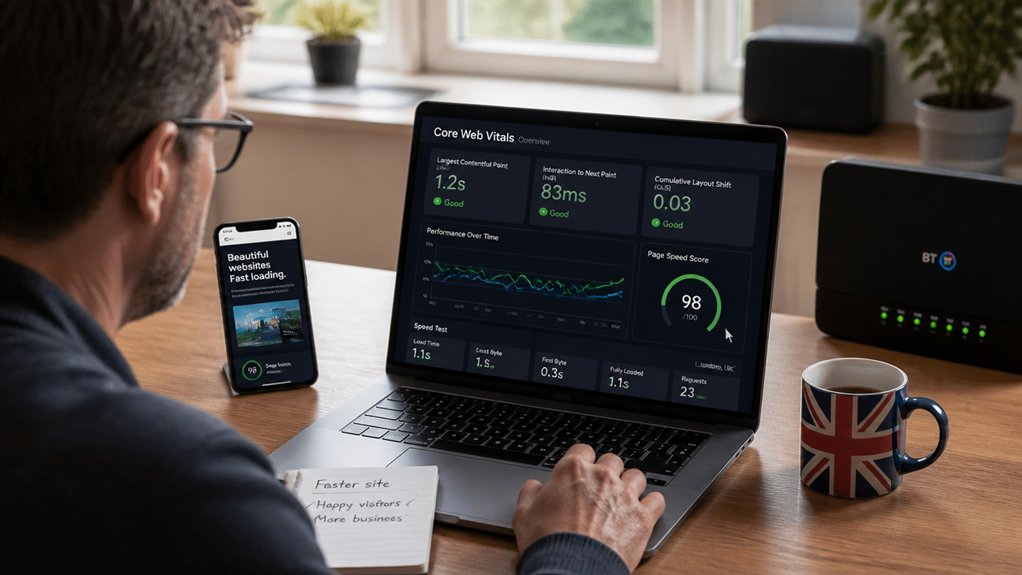
Because Google uses Core Web Vitals as a ranking signal and UK users bounce fast on slow mobile connections, you’ll win more clicks and enquiries by getting your load speed under control.
Aim for LCP under 2.5s, INP under 200ms, and CLS under 0.1, then track results in Search Console and PageSpeed Insights from UK test locations.
Start with the biggest wins: compress and serve images as WebP/AVIF, lazy-load below the fold, and remove unused scripts.
Use a CDN with UK PoPs, enable HTTP/2 or HTTP/3, and cache aggressively.
Minify CSS, inline critical CSS, and defer non-essential JS to protect mobile responsiveness.
Don’t break website accessibility: keep font sizes readable, maintain contrast, and avoid layout shifts that move buttons under thumbs.
Test on 4G and budget Android devices weekly.
Earn Trusted UK Backlinks (Without Spam)
Fast pages help you convert the traffic you earn; trusted UK backlinks help you earn that traffic in the first place. Focus on quality signals: relevant UK sites, real audiences, and editorial links. Skip paid link networks and random directories; they’re easy to spot and rarely drive qualified leads.
Start link building with assets UK publishers actually cite: local stats, pricing benchmarks, “best in” comparisons, or a useful calculator. Then run targeted content outreach: build a list of UK trade bodies, local news sites, niche blogs, suppliers, and partners, and pitch a specific angle tied to their readers.
Prioritise links that send referral visits, not just authority. Track outcomes in Search Console: new linking domains, landing-page impressions, and assisted conversions. Aim for steady growth, not spikes.
Conclusion
You’ve laid your SEO foundations, tuned your Google Business Profile, and matched UK intent with precise on-page keywords. Now keep moving: Core Web Vitals cut bounce rates and lift conversions when speed drops under key thresholds, and local citations strengthen trust signals. Like Theseus following Ariadne’s thread, you’ll stay on course by tracking rankings, calls, and clicks in Search Console and GA4. Earn UK links through partnerships and press—never spam—and you’ll compound gains month by month.
About the Author